AI automation for small businesses: which tasks are worth automating
AI automation pays off for a small business when a task comes up often, follows clear rules and ends with a person checking the result. Here are the workflows that fit that test, the ones that don't, and what the numbers say about who already uses AI, written for business owners, not for people looking for an AI course.
The short answer
Start with the one task that eats the most time every week and runs the same way each time: sorting inquiries, answering common questions, compiling reports, drafting posts. Leave rare tasks and judgment calls to a person or a good template.
- Worth it: tasks that repeat often, follow clear rules and can be checked quickly.
- Not worth it: rare tasks, sensitive decisions, and anything where one mistake is expensive.
- In the EU in 2025, 17% of small businesses with 10 to 49 staff used AI, against 55% of large ones (Eurostat).
- The top reason companies that considered AI didn't use it: a lack of expertise.
- AI prepares, a person decides. That keeps errors small and trust high.
AI workflow automation for small business: six tasks that fit
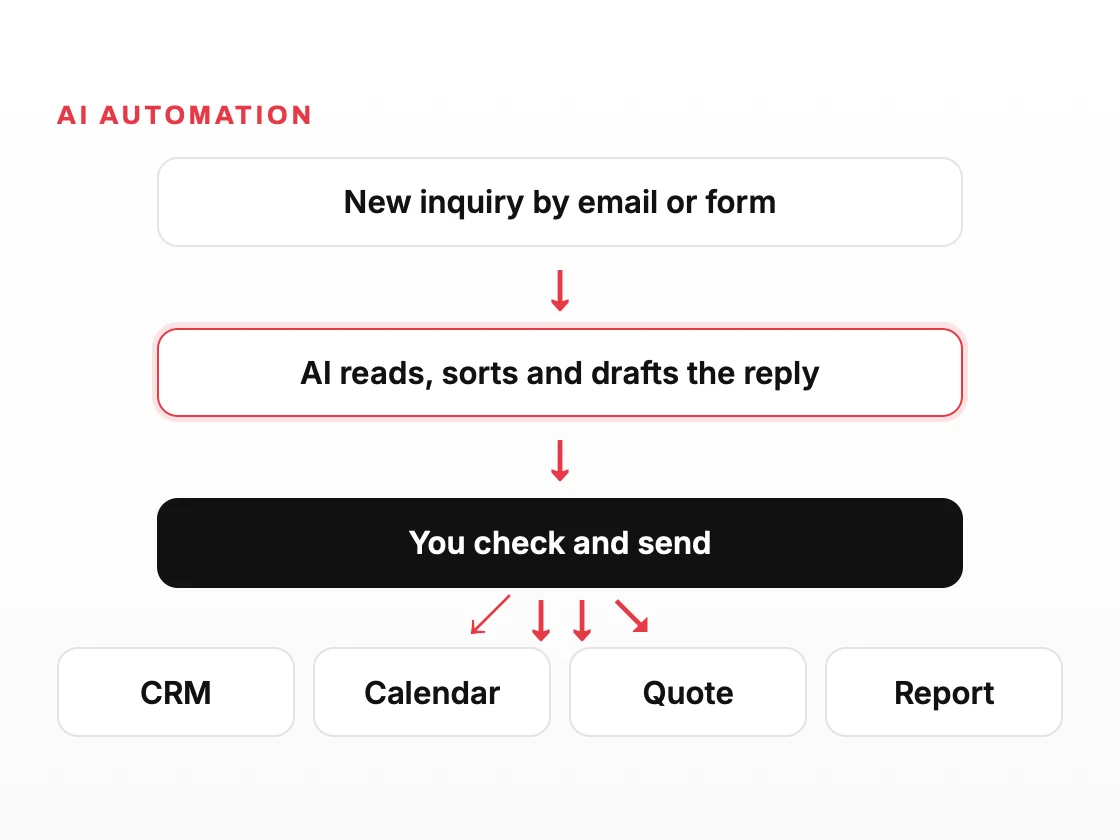
Every example below works the same way: the AI does the sorting or the first draft, and someone on your team approves it.
Sort incoming inquiries
Emails and form entries are tagged by topic and urgency and handed to the right person with a short summary.
Answer common questions
A website assistant handles hours, process and FAQs, and says openly that it is an AI.
Draft replies and quotes
Your notes become a first draft you check and send.
Compile weekly reports
Numbers from ad accounts, your shop or your website land in one short summary each week.
Prepare social posts
One topic becomes drafts for several channels, approved by you.
Check content before it goes live
Pages and texts are checked against your own rules, such as spelling of product names or required details.
- Inquiry arrivesForm, email or website assistant.
- AI sorts itTopic, urgency, the right person.
- One summaryEverything in one place, in three sentences.
- A person repliesYou check and decide.
Is AI automation worth it? A three-question test
Before you buy a tool or pay for a build, run each task through three questions. Only a task with three yeses is a good candidate.
| Question | Yes means | No means |
|---|---|---|
| Does it come up several times a week? | The time saved adds up | A template is usually enough |
| Does it follow the same rules every time? | AI can follow the rule | Keep it with a person |
| Can someone check the result quickly? | Mistakes get caught early | The risk is too high |
Which task costs you the most time?
AI automation tools or a custom build?
Which AI automation tools should a small business use? The honest answer depends less on the tool than on who sets it up, tests it with real cases and keeps it running.
Your own time goes into setup
Your time stays on your business
Good for one simple workflow
Good for workflows that touch several tools
You learn how it works
You get a handover and training
Testing is up to you
Tested with real cases before handover
Best if someone on the team likes tinkering
Best if nobody has the time
If your team wants to learn it, the AI workshop covers AI for marketing content. If you want a workflow that runs, see AI automation for small businesses in Vienna: one workflow at a time, a quote before anything is built.
How many small businesses already use AI
Eurostat surveys businesses with 10 or more staff across the EU; in 2025, 157,000 of about 1.53 million businesses took part. The smaller the business, the less often it uses AI; Eurostat names implementation complexity, economies of scale and cost as possible reasons.
- Small (10–49 staff)17.0%
- Medium (50–249)30.4%
- Large (250+)55.0%
Source: Eurostat, “Use of artificial intelligence in enterprises” (data isoc_eb_ai, extracted December 2025), checked on November 22, 2026. Businesses with fewer than 10 staff are not covered.
Among businesses that had considered AI but didn't use it, the reasons were a lack of relevant expertise (70.9%), unclear legal consequences (52.5%) and data protection concerns (48.8%). Only 20.7% said it simply wasn't useful.
Selling in the EU? Two AI Act rules to know
The EU AI Act (Regulation 2024/1689) is directly applicable in every EU member state. Two articles matter to small businesses using AI day to day:
AI literacy
Providers and deployers of AI systems take measures to support the development of AI literacy of their staff. Since the AI Omnibus amendment (in force since July 27, 2026), no specific level is required.
Chatbots disclose they are AI
Providers must design AI systems that interact directly with people so those people are informed they are interacting with an AI, unless that is obvious.
Source: Regulation (EU) 2024/1689, Articles 4, 50 and 113, consolidated version of July 27, 2026, as amended by the “Digital Omnibus on AI”, in the European Commission's AI Act Service Desk, checked on November 22, 2026. This is a plain summary of the text, not legal advice; for your own case, ask a lawyer.
Frequently asked questions
What can AI automate in a small business?
Tasks that repeat often and follow clear rules: sorting inquiries, answering common customer questions, drafting replies and quotes, compiling reports and preparing social posts. A person checks the result.
Is AI automation worth it for a small business?
Usually, if a task comes up several times a week, runs the same way each time and can be checked quickly. If it comes up only a few times a month, automating it often costs more than it saves, and a template is the better choice.
What are the best AI automation tools for small businesses?
The right tool depends on the software you already use, such as your email, CRM or website. Pick the workflow first, then the tool that fits into what you have, and test it with real cases before you rely on it.
Where do I start with AI automation?
List your repeating tasks for one week with the time each takes. Take the one that costs the most time and passes the three-question test, and try it on real cases from your day-to-day work.
How many small businesses use AI?
According to Eurostat, 17% of EU businesses with 10 to 49 staff used at least one AI technology in 2025, against 30.4% of medium-sized and 55.0% of large businesses.
Do AI chatbots have to say they are AI?
In the EU, Article 50 of the AI Act requires providers to make sure people are informed when they interact with an AI system, unless it is obvious. According to Article 113, this has applied since August 2, 2026. This is not legal advice.
Which task costs you the most time?
Tell Adoro which task repeats every week in your business. In a free 30-minute call, you find out whether AI is worth it or a template is enough. You get a quote after a free first call.
In 30 minutes you get:
- whether AI is worth it for your task, or a template is enough
- then your quote

Anastasia
I'll get back to you personally.