LinkedIn reach down? How often to post, and how to write with AI without sounding like AI
If your LinkedIn reach is down, start with what LinkedIn itself has said: in March 2026 it announced it would show less engagement bait and recycled content and curb comment automation. Here is what that means for your posts, how often to post on LinkedIn, and how to use AI without readers noticing.
The short answer
LinkedIn hasn't named one cause, but its March 2026 feed changes target the very tactics that used to inflate reach. The feed is now ranked by models built to understand what a post is about, and posts designed only to collect reactions are shown less. LinkedIn also says it is working to make engagement pods ineffective and to curb comment automation. If those were carrying your numbers, that is likely where your reach went.
- Substance counts: LinkedIn looks at what a post is about and whether it offers knowledge or advice.
- Bait loses: LinkedIn says it shows fewer “comment to agree” prompts and recycled posts.
- Pods and automation: LinkedIn aims to make engagement pods ineffective and to curb comment automation and tools that fake conversations.
- Rhythm: company pages that post weekly get twice the engagement, according to LinkedIn.
- AI writing: a post reads as AI when nothing in it is yours. What you feed the tool matters more than which tool you use.
How often should you post on LinkedIn?
LinkedIn gives one figure, for company pages: companies that post weekly see a 2x lift in engagement with their content. For personal profiles, LinkedIn publishes no recommended frequency.
| Who posts | A sensible rhythm |
|---|---|
| Company page | Weekly, following LinkedIn's own figure |
| Founder or CEO | As often as you have something of your own to say, on a steady rhythm |
| Expert or engineer | Fewer, deeper posts beat daily filler |
Source: LinkedIn “LinkedIn company page best practices”, checked on November 22, 2026. The figures are for company pages; LinkedIn gives no period or method. The rhythm column is our reading, not a LinkedIn rule.
Why your LinkedIn reach dropped: the 2026 feed update
On March 12, 2026, LinkedIn announced four changes to the feed, already rolling out and still being tested:
Ranking with LLMs
Larger models, augmented with large language models, to understand what a post is about and how a reader's interests change.
Against fake conversations
Action against comment automation, engagement pods and unauthorized third-party tools.
Less bait and recycling
Fewer repetitive, low-substance posts, “comment to agree” prompts and videos that don't match the text.
Better start for new members
An interest picker at sign-up, being tested, so new members see relevant posts from day one.
“Comment YES and I'll send you …”
A post that answers the question itself
The same idea, repackaged for the third time
A topic that matters to your readers
Pods and comment tools
Real replies, written by you
A video that doesn't match the text
An image or video about the post's content
Generic motivation
Knowledge, advice and examples from your work
LinkedIn Help lists the engagement others have with your posts, and how recent it is, among its feed signals. So the first conversation under a post counts: reply yourself, and reply early.
Sources: LinkedIn Pressroom “How LinkedIn Is Improving the Feed to Show More Relevant, Authentic Professional Content” (March 12, 2026) and LinkedIn Help “LinkedIn relevance – Optimizing the member experience”, checked on November 22, 2026.
Posts that sound like you
How to write LinkedIn posts with AI that sound human
An AI post sounds like AI when it is made from nothing: general statements, three bullet points and a closing question. The fix is material only you have. A five-step way to get there:
- Collect materialOne example from your week, one number, one sentence a customer said.
- Draft with AILet it order your material, not invent stories.
- CutDelete filler phrases and the question at the end.
- CheckEvery number and every claim about a company against its source.
- Post it yourselfFrom your own account, and answer comments yourself.
Words that give AI away
Openers like “In today's fast-paced world”, lists of three adjectives, and “Let's dive in”. Not banned, but readers have seen them many times.
Ask instead of prompt
Have someone interview you for ten minutes and record it. Your answers make a better draft than any prompt.
One idea per post
If a post needs subheadings, it is two posts.
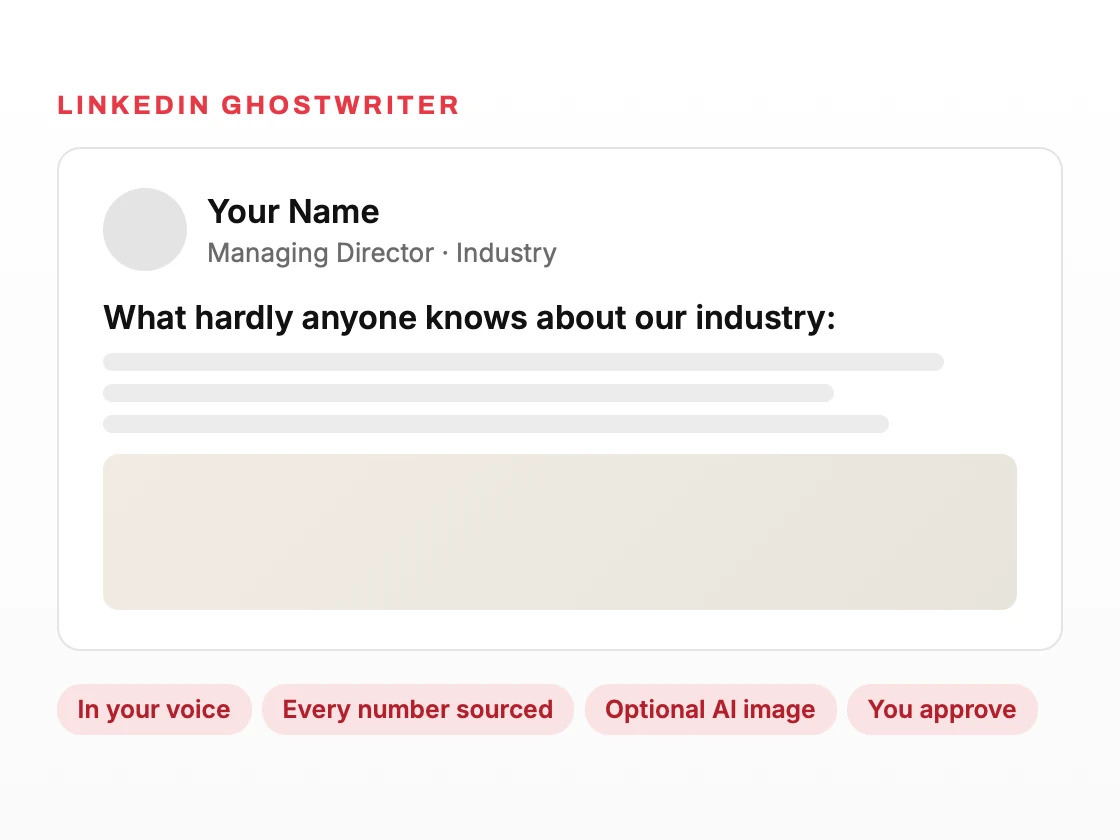
No time to write? You can hand over the interview and the draft and keep approval and replies: LinkedIn ghostwriter for B2B and industry.
What one writer's own LinkedIn series shows
Anastasia writes a LinkedIn series in German about European industrial companies, with the same method for every post. The impressions still spread widely: her strongest post of these four reached about three times as many as the weakest.
- ASML28,202
- ZEISS19,079
- TRUMPF12,926
- SCHOTT9,146
Impressions from LinkedIn analytics on Anastasia's own profile, as of September 22, 2026. Her own posts, not client work. The images in the posts are AI-generated.
The topic matters, not just the frequency. According to LinkedIn analytics, her readers come mainly from machinery, and the largest group works at firms with 10,000+ staff. Knowing your readers helps you pick topics that concern them. Nobody can promise reach: your readers and LinkedIn decide that.
If a strong post should reach more decision-makers, a company can promote it as a Thought Leader Ad: How much do LinkedIn ads cost?
Frequently asked questions
Why did my LinkedIn reach drop?
LinkedIn names no single cause. In March 2026 it announced that it shows less engagement bait and recycled content and that it is working to make engagement pods ineffective and curb comment automation. If your reach came from those, it is likely to drop.
How often should I post on LinkedIn?
For company pages, LinkedIn says companies that post weekly see twice the engagement. For personal profiles there is no official number. A steady rhythm with substance beats daily posts without it.
How often should a company post on LinkedIn?
Weekly, if you follow LinkedIn's own figure: company pages that post every week get twice the engagement. Posts with an image typically get a 2x higher comment rate, according to LinkedIn.
Does LinkedIn penalize AI-generated posts?
LinkedIn doesn't say it ranks AI text lower as such. It does look at what a post is about and whether it offers knowledge or advice, and it shows generic and repeated posts less. By those rules, what is in the post counts, not the tool behind it.
How do I write LinkedIn posts with AI that sound human?
Give the AI your own material: an example, a number, an opinion. Let it order, not invent. Cut filler, check every number, then post and reply yourself.
Is LinkedIn reach the same as impressions?
Not quite. In LinkedIn's post analytics, impressions count how often your post was displayed, and members reached counts the distinct members and pages who viewed it; repeat views aren't counted. One person who sees a post twice adds two impressions.
Posts that sound like you
Tell Adoro what you want to talk about on LinkedIn and who should read it. In the free first call, you see how the interview, drafts and approval work. You get a quote after a free first call.
In 30 minutes you get:
- how the interview, drafts and approval work
- then your quote

Anastasia
I'll get back to you personally.